2017-11-28: The Emerging Revolution in Engineering
Presented by Ranjit Sahai, PE, F.ASCE, Principal at RAM Corporation

The first revolution in surface transportation saw a shift in motive power from muscle to motor, i.e. from bicycle to automobile. The revolution cut down time five-fold to travel non-stop from the West to the East coast: 10-days for a bike vs 2-days for an automobile.
The tools we use to create design documentation, i.e. engineering drawing, also saw a revolutionary shift from paper drafting to computer-aided design and drafting: from the eighteenth to the twentieth centuries. The revolution made it possible to extract engineering drawings automatically from 3D design models—an utterly new way to document engineering design. Another revolution is emerging that is transforming the worlds of design and construction in engineering.
With examples drawn from transportation engineering, the presentation highlights the significant discoveries and innovations that led to the earlier shifts and teases out the underpinnings of the next shift that is upon us. An understanding of these shifts is essential to envision the aspects of your technical specialty—whether planning, design, construction, or operation—that are likely to change, and to build the skills needed to leap ahead.
WHEN: Tuesday, November 28, 2017, 11:45 AM – 1:15 PM (Lecture starts at noon)
WHERE: GWU, Lehman Auditorium, Rm B1220, 800 22nd St NW, Washington, DC
Attendees with receive one Professional Development Hour at this no-cost event. Pizza will be served.
2017-10-24: Impact on Traffic Flow Performance from CVs & AVs
Presented by Dr. Samer Hamdar, Transportation Program Director, GWU
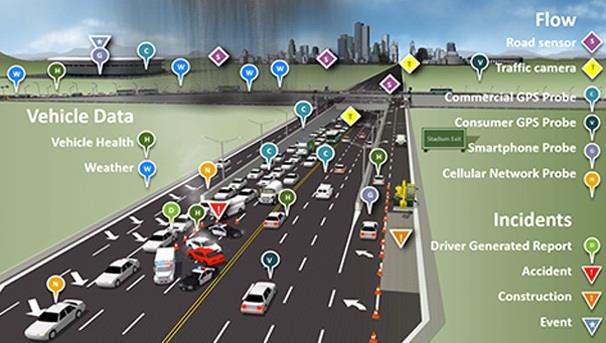
Traffic flow capacity drops significantly on roadway segments when bottlenecks are created by high traffic volumes, accidents, and weather conditions. Does traffic flow performance improve with the introduction of connected and automated vehicles on our highways? The George Washington University (GW) Transportation Research Group has been conducting research to answer that question. To this end, it relies on:
- Continuous Count Station (CCS) data administrated by Virginia Department of Transportation (VDOT) in Northern Virginia
- Collision data administered by National Highway Traffic Safety Administration (NHTSA)
- Weather data published by the Weather Channel
An analysis of this data leads to the identification of different regimes or conditions, namely, normal commute condition, incident condition, and inclement weather condition. The Intelligent Driver Model (IDM) is then used to compute behavioral parameters that result in the identified regimes. These parameters are then modified to account for the connectivity and automation in driverless vehicles and thus to evaluate the impact of such technology (i.e. connected and automated vehicle technologies) on traffic performance. Finally, the research team conducts a validation effort through vehicle instrumentation at the Vehicle Instrumentation Garage (VIG) located at the GW Virginia Science and Technology Campus (VSTC).
The event was hosted by ASCE-NCS Transportation Committee (Stuart Crooks, HNTB: Chair; Robert Kalbach, WSP: Vice Chair; Alvaro Oviedo, RAM: Secretary; Ranjit Sahai, RAM: Committee Director). This lecture kicked off the Transportation Committee's for ASCE-NCS’ 2017-18 fiscal year.
2017-04-11: Ethics 101
Ethics is a vital topic; it is concerned with how you evaluate choices to determine which is good or evil, right or wrong, desirable or undesirable. Ethics is a human necessity. It also helps you discover how to assess if situations that make you queasy have ethical implications.
During this session, attendees:
- Learned about the three foundation principles of ethics
- Related these principles to those in the ASCE Code of Ethics
- Reviewed the application of these principles in an ethical case reported to ASCE Committee on Professional Conduct
- Discovered the link to resources on ethics that are made available by ASCE to its members
Those registered in the State of Maryland took advantage of this session to fulfill their 1 PDH requirement on ethics. Those of you registered in the Commonwealth of Virginia and/or the District of Columbia also added 1 PDH toward their license renewal.
About the Speaker: Ranjit Sahai, PE, F.ASCE is the 2013-14 ASCE-NCS Past President. He is an author and principal at RAM Corporation, a consulting engineering firm focused on traffic engineering, storm water management, and technology projects. He has a keen interest in philosophy and has completed several online courses on the topic. Join the NCS Transportation Committee at this session to not only receive a PDH toward your PE license renewal but also to learn from ethical cases ASCE highlights in its monthly communication with its members.
2016-03-08: Innovations in Airport Pavement Design
George Washington University, DC (March 8, 2016): The majority of US airports were built during World War II with concrete runways. Since then, major advancements in pavement engineering have emerged as these aging runways require rehabilitation or reconstruction. Discover modern airport pavement design methods, which provide increased safety, longevity, constructability and sustainability. Mr. Weaver discussed the basics and history of airfield pavement design and supplemented it with a case study involving pavement design methods to mitigate the punishing effects of one of the most unusual military aircraft, the MV-22 Osprey.
Hugh F. Weaver, PE, LEED AP BD+C is the National Aviation Engineering Practice Leader at HNTB Corporation, a civil engineer, airfield designer and an expert in the field of airfield pavement engineering. Mr. Weaver began his engineering career in 1987, practicing engineering at small rural general aviation airports. Over time, he expanded his horizons with larger and more complex airports, including major airlines hubs and military installations. His work has taken him around the world, working in diverse environments and cultures. Hugh holds a Bachelor of Science Degree in Civil Engineering Technology and is a registered professional engineer in Georgia, Pennsylvania, Texas and North Carolina. He is a member of the Aircraft Owners and Pilots Association (AOPA), the American Consulting Engineers Council (ACEC), and the Society of American Military Engineers (SAME).
The next presentation by the Transportation Committee of ASCE-NCS will be held on May 10th, 2016. Please look forward to details on the ASCE-NCS website. http://www.asce-ncs.org/index.php/committees/transportation.
2016-01-11: Focus on Non-Destructive Inspection Technologies
University of the District of Columbia (January 11, 2016): A group of approximately 30 people, both young and old, gathered at UDC for the ASCE-NCS Transportation Committee meeting this evening. A civil engineering student was overheard asking, “How much load should a bridge be designed to carry?” The answer he received from an engineering practitioner helped guide his thoughts away from the “should” he struggled with, to the identification of relevant design loads through planning activities. The intermingling of students, practitioners and educators while dining over pizza indeed delivered several insights of value to attendees.
Larry Olson of Olson Engineering, widely known for his expertise in nondestructive evaluation (NDE) and performance monitoring of civil infrastructure including dams, bridges, buildings, foundations, pavements, and tunnels presented the topic “Assessing Concrete Decks: GPR & Impact Echo Scanning”. His skill and experience as a trainer was evident. He kept the audience engaged by pausing to ask questions when he saw attention wavering and adjusted his content delivery. His key message was that a deck evaluation method that is both comprehensive and economical is the use of non-destructive evaluation techniques that can look well below the surface. He showcased Ground Penetrating Radar (GPR) and similar NDE techniques, such as Impact Echo Scanning. He noted that when armed with the results of such evaluations, engineers can develop appropriate mitigation strategies more confidently and cost effectively.
The next presentation by the Transportation Committee of ASCE-NCS will be held on March 8th, 2016. The speaker Hugh Weaver, PE is an expert on aviation pavement with over 30 years of experience at airports across the country will be presenting on “Recent Innovations in Airport Pavement Design”. Please look forward to details on the ASCE-NCS website. http://www.asce-ncs.org/index.php/committees/transportation.