2019-01-16: A 21st Century Vision for America's Highways
Register HERE with credit card, or pay at the door. Please register by Monday, January 14!
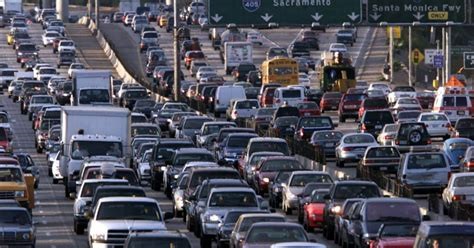
America’s highways were built over two generations ago. Congestion is a major problem in all major cities and so is the state of highway infrastructure due to the chronic underfunding for maintenance and capital improvements. There must be a better way forward.
Robert Poole, a noted thought leader in the transportation industry, examines the current model for operation and maintenance of highways and explains why that model had to fail to meet today’s demands. He draws on his over 20-year work as a transportation policy expert and explores a different model for their operation and maintenance; a model that, when adopted, has served other industries and nations well. Join us for this must-attend event to listen to a 21st century vision that has the potential to reduce congestion and improve infrastructure.
WHEN: Wednesday, January 16, 2018, 11:45 AM - 1:15 PM (Sign-in and catered lunch begin at 11:45 AM, with speaker at 12:00 PM)
WHERE: WSP, DC Office - 1015 Half St SE, Suite 650, Washington, DC 20003
COST: $20 per person (member) $25 (nonmember)
Attendees will receive (1.0) Professional Development Hour (PDH).
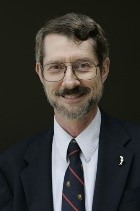
About the speaker: Robert Poole earned a B.S. and M.S. from MIT and has advised the Reagan, George H.W. Bush, Clinton, and George W. Bush administrations on privatization and transportation policy. He has written many articles, papers, and books on privatization (the contracting-out of public services) and transportation issues. In May 2018, the ENO Center for Transportation honored Robert Poole with the ENO Thought Leader Award. He is also the author of the book “Rethinking America’s Highways” published in August 2018 by University of Chicago Press.
2018-10-30: "Bridging Urban America" Film Screening
The Transportation Committee of the ASCE National Capital Section is proud to be screening an outstanding film about the life and work of Ralph Modjeski, a master bridge builder.
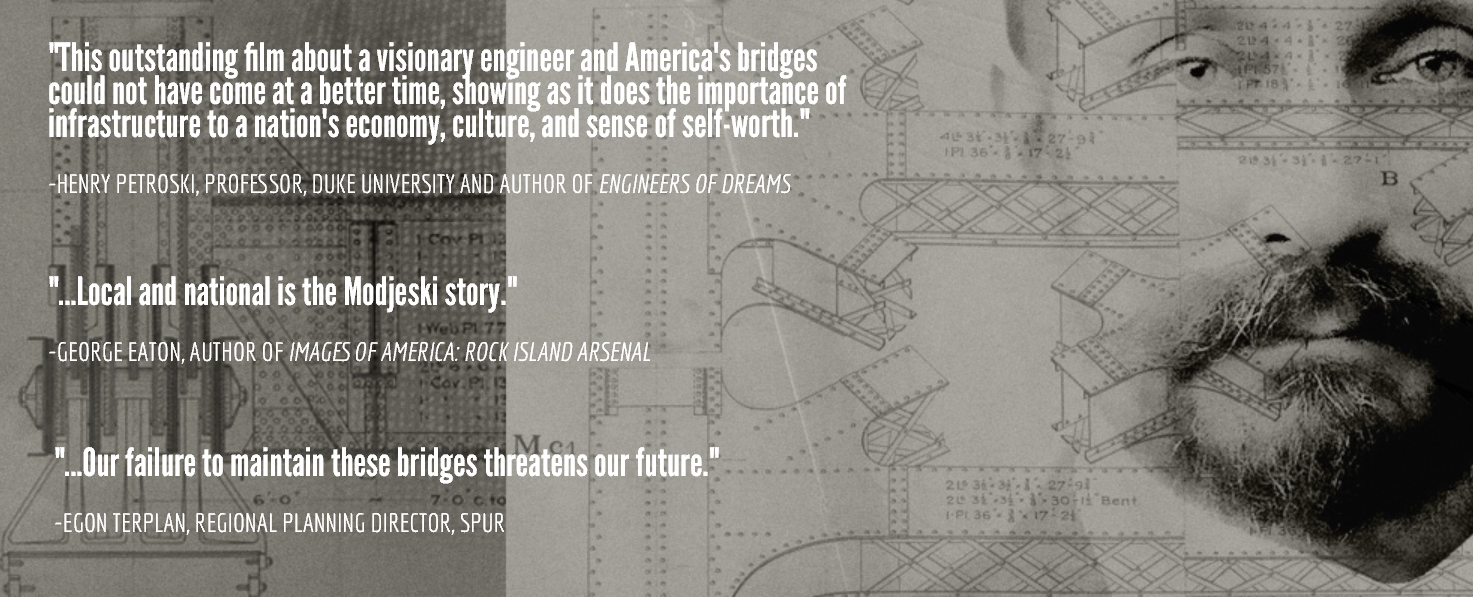
Railroads and bridges played a vital role during the Industrial Revolution to transform the American way of life. The accomplishments of civil engineers were even celebrated in everyday life, as evidenced by the long list of songs located here, that were popular then. The NCS Transportation Committee is proud to present the 90-minute film Bridging Urban America, a story of Ralph Modjeski, a civil engineer who designed some of the most iconic bridges of that period. Come walk the halls of history to watch the life and works of a master bridge builder and be inspired to mold the future as age of the hyperloop and connected transportation takes shape.
WHEN: Tuesday, October 30, 2018, 11:15am. Following some brief announcements about the upcoming year for the Transportation Committee, the film will start at 11:30am and run for 90 mins.
WHERE: WSP, 13530 Dulles Technology Drive, Suite 300, Herndon, VA 20171
COST: $10. Lunch is included (eat while you watch).
PDH: Certificate for 1.5 PDH will be issued.
TO REGISTER, EMAIL:
Please RSVP by Friday, October 26, 2018
The New Infrastructure Plan and Transportation Funding
Understanding the nation's infrastructure needs and future plans and keeping track of the myriad of transportation funding options is a tough job in the calmest of years, and today's political climate has made this an even greater challenge. In this constantly changing world, staying on top of transportation funding is a full-time job. While ASCE members and industry professionals are always up to the challenge of developing designs for the most complicated infrastructure needs, navigating the legislative pathways that lead to the funding that pays for the design and construction can be daunting.
In this month's ASCE NCS Transportation Committee lecture, Cathy Connor, WSP's Director of Federal Government Affairs will provide an update on the Trump Administration's new Infrastructure Plan, what it means to the industry, and what funding options are now available and how you or your clients can take advantage of them to advance your programs. In addition to the Trump Infrastructure Plan, she will discuss the FY 18 and FY 19 USDOT budget/appropriations and FAST Act reauthorization, and the related looming insolvency of the Highway Trust Fund. As anyone who watches the news or follows Twitter feeds knows, things change quickly these days, so by March 27, there may be even more to discuss.
WHEN: Tuesday, March 27, 2018, 11:45AM - 1:10PM (lecture starts at noon)
WHERE: WSP USA Inc., 1015 Half Street SE, Suite 650, Washington, DC 20003
(near Navy Yard-Ballpark Metro Station)
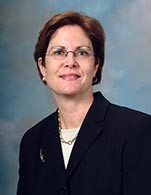
Cathy Connor is a Senior Vice President and Director of Federal Government Affairs for WSP (formerly Parsons Brinckerhoff), located in the Washington, DC office. She was previously with the American Council of Engineering Companies (ACEC), where she was Deputy Director of Government Affairs, and prior to that, was a political appointee at the US Department of Transportation where she served as Special Assistant to the Assistant Secretary for Governmental Affairs. Cathy is responsible for directing WSP's federal legislative, regulatory and political activities. Her extensive experience includes working with industry, federal agency and congressional staff on key infrastructure legislation, such as MAP-21, FAA Reauthorization and PRRIA. Cathy also helps clients identify federal funding sources and plan legislative strategies. She acts as the firm's liaison to numerous industry associations and legislative coalitions where she serves in various leadership roles and speaks at industry events. She is frequently quoted in ENR, Civil Engineering magazine and other industry publications on federal legislative activities.
2017-11-28: The Emerging Revolution in Engineering
Presented by Ranjit Sahai, PE, F.ASCE, Principal at RAM Corporation

The first revolution in surface transportation saw a shift in motive power from muscle to motor, i.e. from bicycle to automobile. The revolution cut down time five-fold to travel non-stop from the West to the East coast: 10-days for a bike vs 2-days for an automobile.
The tools we use to create design documentation, i.e. engineering drawing, also saw a revolutionary shift from paper drafting to computer-aided design and drafting: from the eighteenth to the twentieth centuries. The revolution made it possible to extract engineering drawings automatically from 3D design models—an utterly new way to document engineering design. Another revolution is emerging that is transforming the worlds of design and construction in engineering.
With examples drawn from transportation engineering, the presentation highlights the significant discoveries and innovations that led to the earlier shifts and teases out the underpinnings of the next shift that is upon us. An understanding of these shifts is essential to envision the aspects of your technical specialty—whether planning, design, construction, or operation—that are likely to change, and to build the skills needed to leap ahead.
WHEN: Tuesday, November 28, 2017, 11:45 AM – 1:15 PM (Lecture starts at noon)
WHERE: GWU, Lehman Auditorium, Rm B1220, 800 22nd St NW, Washington, DC
Attendees with receive one Professional Development Hour at this no-cost event. Pizza will be served.
2017-10-24: Impact on Traffic Flow Performance from CVs & AVs
Presented by Dr. Samer Hamdar, Transportation Program Director, GWU
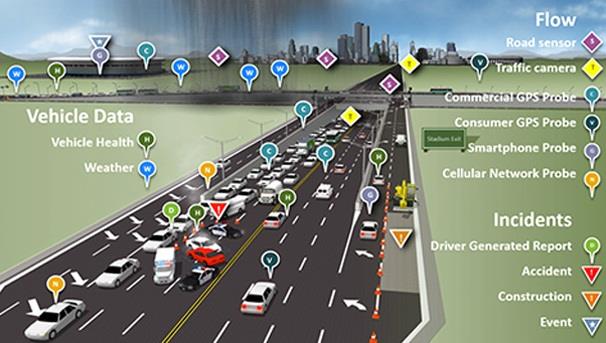
Traffic flow capacity drops significantly on roadway segments when bottlenecks are created by high traffic volumes, accidents, and weather conditions. Does traffic flow performance improve with the introduction of connected and automated vehicles on our highways? The George Washington University (GW) Transportation Research Group has been conducting research to answer that question. To this end, it relies on:
- Continuous Count Station (CCS) data administrated by Virginia Department of Transportation (VDOT) in Northern Virginia
- Collision data administered by National Highway Traffic Safety Administration (NHTSA)
- Weather data published by the Weather Channel
An analysis of this data leads to the identification of different regimes or conditions, namely, normal commute condition, incident condition, and inclement weather condition. The Intelligent Driver Model (IDM) is then used to compute behavioral parameters that result in the identified regimes. These parameters are then modified to account for the connectivity and automation in driverless vehicles and thus to evaluate the impact of such technology (i.e. connected and automated vehicle technologies) on traffic performance. Finally, the research team conducts a validation effort through vehicle instrumentation at the Vehicle Instrumentation Garage (VIG) located at the GW Virginia Science and Technology Campus (VSTC).
The event was hosted by ASCE-NCS Transportation Committee (Stuart Crooks, HNTB: Chair; Robert Kalbach, WSP: Vice Chair; Alvaro Oviedo, RAM: Secretary; Ranjit Sahai, RAM: Committee Director). This lecture kicked off the Transportation Committee's for ASCE-NCS’ 2017-18 fiscal year.