2017-04-11: Ethics 101
Ethics is a vital topic; it is concerned with how you evaluate choices to determine which is good or evil, right or wrong, desirable or undesirable. Ethics is a human necessity. It also helps you discover how to assess if situations that make you queasy have ethical implications.
During this session, attendees:
- Learned about the three foundation principles of ethics
- Related these principles to those in the ASCE Code of Ethics
- Reviewed the application of these principles in an ethical case reported to ASCE Committee on Professional Conduct
- Discovered the link to resources on ethics that are made available by ASCE to its members
Those registered in the State of Maryland took advantage of this session to fulfill their 1 PDH requirement on ethics. Those of you registered in the Commonwealth of Virginia and/or the District of Columbia also added 1 PDH toward their license renewal.
About the Speaker: Ranjit Sahai, PE, F.ASCE is the 2013-14 ASCE-NCS Past President. He is an author and principal at RAM Corporation, a consulting engineering firm focused on traffic engineering, storm water management, and technology projects. He has a keen interest in philosophy and has completed several online courses on the topic. Join the NCS Transportation Committee at this session to not only receive a PDH toward your PE license renewal but also to learn from ethical cases ASCE highlights in its monthly communication with its members.
2016-03-08: Innovations in Airport Pavement Design
George Washington University, DC (March 8, 2016): The majority of US airports were built during World War II with concrete runways. Since then, major advancements in pavement engineering have emerged as these aging runways require rehabilitation or reconstruction. Discover modern airport pavement design methods, which provide increased safety, longevity, constructability and sustainability. Mr. Weaver discussed the basics and history of airfield pavement design and supplemented it with a case study involving pavement design methods to mitigate the punishing effects of one of the most unusual military aircraft, the MV-22 Osprey.
Hugh F. Weaver, PE, LEED AP BD+C is the National Aviation Engineering Practice Leader at HNTB Corporation, a civil engineer, airfield designer and an expert in the field of airfield pavement engineering. Mr. Weaver began his engineering career in 1987, practicing engineering at small rural general aviation airports. Over time, he expanded his horizons with larger and more complex airports, including major airlines hubs and military installations. His work has taken him around the world, working in diverse environments and cultures. Hugh holds a Bachelor of Science Degree in Civil Engineering Technology and is a registered professional engineer in Georgia, Pennsylvania, Texas and North Carolina. He is a member of the Aircraft Owners and Pilots Association (AOPA), the American Consulting Engineers Council (ACEC), and the Society of American Military Engineers (SAME).
The next presentation by the Transportation Committee of ASCE-NCS will be held on May 10th, 2016. Please look forward to details on the ASCE-NCS website. http://www.asce-ncs.org/index.php/committees/transportation.
2016-01-11: Focus on Non-Destructive Inspection Technologies
University of the District of Columbia (January 11, 2016): A group of approximately 30 people, both young and old, gathered at UDC for the ASCE-NCS Transportation Committee meeting this evening. A civil engineering student was overheard asking, “How much load should a bridge be designed to carry?” The answer he received from an engineering practitioner helped guide his thoughts away from the “should” he struggled with, to the identification of relevant design loads through planning activities. The intermingling of students, practitioners and educators while dining over pizza indeed delivered several insights of value to attendees.
Larry Olson of Olson Engineering, widely known for his expertise in nondestructive evaluation (NDE) and performance monitoring of civil infrastructure including dams, bridges, buildings, foundations, pavements, and tunnels presented the topic “Assessing Concrete Decks: GPR & Impact Echo Scanning”. His skill and experience as a trainer was evident. He kept the audience engaged by pausing to ask questions when he saw attention wavering and adjusted his content delivery. His key message was that a deck evaluation method that is both comprehensive and economical is the use of non-destructive evaluation techniques that can look well below the surface. He showcased Ground Penetrating Radar (GPR) and similar NDE techniques, such as Impact Echo Scanning. He noted that when armed with the results of such evaluations, engineers can develop appropriate mitigation strategies more confidently and cost effectively.
The next presentation by the Transportation Committee of ASCE-NCS will be held on March 8th, 2016. The speaker Hugh Weaver, PE is an expert on aviation pavement with over 30 years of experience at airports across the country will be presenting on “Recent Innovations in Airport Pavement Design”. Please look forward to details on the ASCE-NCS website. http://www.asce-ncs.org/index.php/committees/transportation.
2015-11-10: Impact on Traffic Mobility of V2V Communication
George Washington University (November 10, 2015): How will vehicle-to-vehicle communication impact your commute? Our speaker, Dr. Samer Hamdar, an assistant professor at the George Washington University (GWU) and the Director of the Center of Intelligent Systems Research (CISR – www.cisr.gwu.edu), provided a research-based perspective to this question.
With billions of vehicle miles traveled annually in the U.S alone, significant improvements associated with traffic mobility and safety are needed. Such improvements are represented by an increase in traffic stability and a reduction in congestion. Interactions between individual drivers and errors in the driving decision making processes have been previously identified as major contributors to unsafe and unstable traffic conditions. Two main avenues that reduce/remove human error from the driving experience are being pursued.
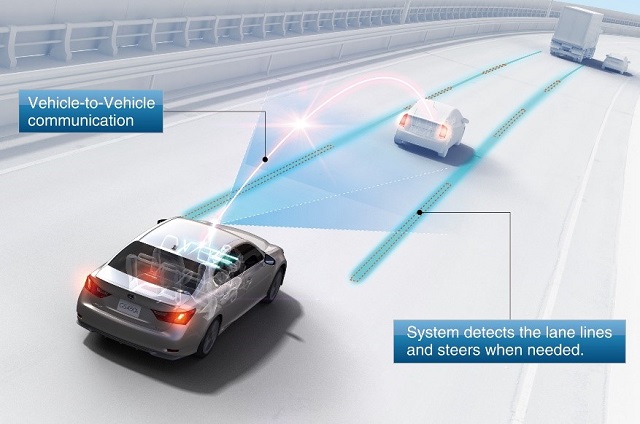
Autonomous vehicles use sensing technology to take on the burden of driving, while connected vehicles incorporate vehicle-to-vehicle and vehicle-to-infrastructure communication to obtain and share information that can allow the driver/vehicle to make better driving decisions.
After presenting existing applications of connected vehicle (CV) technologies as foreseen by the Federal Highway Administration, shared the findings of his research that models the traffic stability of different market penetration rates (MPRs) of connected and autonomous vehicles with focus on car-following and lane-changing maneuvers. The results show an increase in roadway capacity and an improvement in traffic stability as the MPR and the CV level of control increase. However, the greatest benefit comes when all vehicles on the road are autonomous with no human drivers!
2015-09-08: Risk Informed Civil Project Delivery
George Washington University (September 8, 2015): More often than not, civil infrastructure mega-projects come in over budget while the scope increases as the project moves forward. Why is that? And what can we do about it?
Michael O’Connor shared his insights that he learned in the trenches as a risk manager and direct report to first the director of Federal Transit Administration’s Office of Engineering in its Office of Program Management and then the Regional Administrator in Region II (New York City). His responsibilities included program development for technical requirements in cost and schedule modeling and contingencies; validating megaproject cost and schedules for projects with total value over $25 billion. He provided major inputs into FTA’s proposed rulemaking on risk management including concepts of management capacity and organizational capacity, risk definitions and risk mitigation classification and sequence.