Dr. Z’s Corner (202110) - Bitcoin and Currently More than 12,000 Cryptocurrencies: A Hope or a Threat?

How it all started
In 2008, a novel paper was introduced to the world, titled “Bitcoin: A Peerto-Peer Electronic Cash System”, written by Satoshi Nakamoto. In this paper, a new idea was explained about a system for electronic transactions that do not rely on trust. In other words, no “trusted third party” is needed for the system to work. The physical person behind the name “Satoshi Nakamoto” has never been found and the real identity of Nakamoto still remains a mystery.
Money and the need for a “trusted third party”
In the long past, there were no monetary mediums. People in primitive societies would simply exchange goods using a barter arrangement. Bartering is the exchange of goods and services between two parties without the use of money, based on equivalent estimates of prices and goods. One of its main limitations is that one cannot store wealth in the long term.
Then came money, in the form of a shell, a metal coin, or a piece of paper that people could use as a medium of exchange, a unit of measurement of value and a storehouse for wealth. The invention of money played a significant role in the evolution and development of human societies as it allowed people to trade goods and services indirectly, providing also an effective way to store wealth. Historians believe that metal objects were first used as money as early as 5,000 BC.
The 21st century gave rise to a new form of currency, digital money, allowing digital, mobile payments. Mobile payments are money rendered for a product or service through a portable electronic device, such as a cell phone, smartphone, tablet device or a computer. Money nowadays sits in bank accounts and needs not have a physical form. Mobile payments offer the advantage that the two parties do not need to be in the same physical location for the transaction to take place. Unlike hand-to-hand physical payments by cash, digital payments can be made remotely, through a bank. The bank acts as an intermediary or a trusted third party. When Helen pays John the amount of $100.00 remotely, she makes the relevant request at a bank online. The bank needs to verify and process the transaction. It first checks if Helen has $100.00 at her disposal. If yes, it proceeds with the payment to John. It will debit Helen’s account with the amount of $100.00 and credit John’s account with the same amount. In such double entry bookkeeping, debits and credits are entries made in account ledgers to record changes in value.
These online payments need a trusted third party to act as an intermediary. Unlike cash transactions that are truly peer-to-peer, traditional online payments need to go through a bank. This can cause problems and difficulties as banks may delay or censor transactions, while in some cases transaction fees may be too high. This is the case with international payments between two banks in distant countries and especially when a third world country is involved. In addition, one needs to open a bank account to send or receive payments. There are certain requirements for opening an account and rules on who can pay and who can get paid. Privacy is another concern as a lot of personal information is revealed in every transaction and the bank or a bank employee has access to this sensitive information.
The “beauty” of cash, digital cash and the “doublespending problem”
Cash payments do not have these problems. The beauty of cash lies in the fact that there are no intermediaries. But cash has another problem: For example, when Helen gives John a bank note of $100.00, the two parties need to be in the same place at the same time. In addition, cash is bulky and therefore it cannot be easily used for big transactions. The question arises: Could we have online payments that are just like cash, i.e. peer-topeer, with no need for intermediaries, no banks, no delays, no censorship and no privacy issues? Is there a way to have digital money that behaves exactly like cash?
Many researchers had tried to deal with this issue, but they faced the so-called “double-spending problem”. Double spending is the risk that a digital currency can be spent twice. Physical currencies do not have this problem because they cannot be easily replicated, and the involved parties in a transaction can easily verify the authenticity and past ownership of the physical currency. In other words, with digital currency there is a risk that the holder of the digital currency might make a copy of the digital token and send it as payment, while retaining the original.
The solution to the doublespending problem
Bitcoin was the first successful implementation managing to solve the double spending problem. It was described as a peer-to-peer electronic cash system. The code of Bitcoin was released in 2009, after the publication in 2008. In Bitcoin, there is no bank, no central system, no single institution in the middle playing a special role. That’s why it is called a “decentralized network”. All players in this network are equal and there is no central or special player. The technology that enabled Bitcoin to make this breakthrough, is called Blockchain. Bitcoin and other cryptocurrencies, all based on blockchain technology, offer peerto-peer transactions with privacy for any amount of money, just like cash!
In a blockchain, timestamps for a transaction are added to the end of previous timestamps based on proofof-work, creating a historical record. Because the record of transactions is distributed across many nodes in the system, it is practically impossible for a bad actor to gain enough control of the system to rewrite the ledger to their own advantage. The blockchain records are kept secure because the amount of computational power required to reverse them is enormous. This technology allows Bitcoin to transfer value across the globe without resorting to traditional intermediaries, such as banks.
Bitcoin controversy
For many, Bitcoin is the ultimate democratic tool and the currency of the future. Its advantages include the following:
- Payment freedom. Bitcoin allows us to send and receive money anywhere in the world, peer to peer, at any time.
- Availability. It is theoretically available to populations of users without access to traditional banking systems, credit cards, and other methods of payment.
- Total control over our money. There is no form of central authority in the Bitcoin network.
- Security. The protocol cannot be manipulated by any organization, government or bad actor, because Bitcoin is cryptographically safe. The network remains secure even if not all of its users can be trusted.
- Transparency. The information is fully transparent. With the blockchain, all completed transactions are visible to everyone, but personal information remains hidden.
- Low fees. Although there are transaction fees to be paid, they are very low.
On the other hand, some economists have characterized Bitcoin as a speculative bubble or even an advanced Ponzi scheme. Bitcoin has been criticized for:
- Use in illegal transactions. Bitcoin offers a dark medium to engage in illegal activities including money laundering, financing terrorism, collecting ransoms in hacks or cyberattacks, and buying or selling banned substances.
- Large carbon footprint. Bitcoin is power-hungry as it is “mined” (created) using high-powered computers around the globe. Cambridge researchers claim that mining Bitcoin currently consumes around 110 Terawatt Hours per year. That’s roughly 0.55 percent of global electricity production, and more energy than the annual consumption of countries such as Argentina, Malaysia, and Sweden.
- Price volatility. Since it was first introduced, Bitcoin has had a choppy and volatile trading history. Its price has undergone multiple bubbles in a short history. It reached an all-time high price of $64,863 on April 14, 2021.
- Scalability problem and low speed. The scalability problem refers to the limited capability of the Bitcoin network to handle large amounts of transaction data on its platform in a short span of time. Bitcoin processes 4.6 transactions per second on average, compared to Visa’s 1,700-plus per second. For many, this is a major barrier to its wider adoption.
Conclusion and discussion
Bitcoin is a new and experimental currency in continuous development. It has many advantages that physical money does not provide to its users, however, it also has disadvantages. Various other cryptocurrencies use a consensus mechanism called proofof-stake (PoS), which is much less energy-intensive than the Proof-ofWork technology on which Bitcoin is based. The No. 2 cryptocurrency, Ethereum, is moving to PoS soon. This can solve one of the major problems of Bitcoin and other cryptocurrencies, which is the large carbon footprint of traditional mining.
With more than 12,000 different cryptocurrencies now listed by CoinMarketCap, competition between bitcoin and other major cryptocurrencies is reaching a fever pitch. Cryptocurrency is a nascent phenomenon and numerous unresolved issues still remain before it becomes close to reshaping the major shortcomings of today’s financial systems.
Dr. Vagelis Plevris
About the Author
Dr. Vagelis Plevris is an Associate Professor at the Department of Civil and Architectural Engineering of Qatar University in Doha, Qatar. Currently, Dr. Plevris serves as the Chief Editor for “Computational Methods in Structural Engineering”, a section of the journal Frontiers in Built Environment, by Frontiers in Switzerland.
Dr. Z’s Corner (202111) - Risk Irrationality: How COVID-19 Changed the World and How Enterprise Risk Management Deflates Conspiracy and Irrationality the First Time
Allianz Global Corporate & Specialty (AGCS) is a leading global corporate insurance carrier. Each year they conduct a survey of global businesses that identifies the ten most important risks to business and industry. The 2020 Allianz Risk Barometer identified cyber incidents, business interruption and changes in legislation and regulation as the three most important global risks. Pandemic risk was nowhere to be found among the risks of concern. The 2021 Allianz Risk Barometer identified business interruption, pandemic outbreak, and cyber incidents-dubbed the COVID trio-as the three risks of greatest importance. COVID was a game changer for every organization on the planet and it was not on the radar for most businesses.
Many years ago, a college instructor related the apocryphal tale of a fictional US Patent office employee who was supposedly tasked with approving the production and use of the automobile. One night he dreamed of a world where this new invention made it possible for people to spend more time with friends and family, see new places, do jobs they otherwise could not do, and earn a good living. But then the dream turned on him and he saw forests and plains cleaved in two by asphalt ribbons, a sky clouded by pollution, landscape dotted with the carcasses of old automobiles, over 35,000 deaths per year, and bodies horribly broken and mangled. How could he approve such a wondrous invention that came at such a high cost?
We live in the world that fictional fellows dreamed of. We accept all the risks associated with the automobile because they have always been part of our lives. We cannot imagine a world without the freedom and benefits the automobile offers. The Allianz Risk Barometer is unlikely to ever consider the automobile a salient risk. It is a classic example of our irrationality about risk. Instead of addressing the guaranteed annual loss of over 35,000 lives in the United States alone, we fixate on a more salient risk. On April 13, 2021, CDC and FDA recommended a pause in the use of Johnson & Johnson’s Janssen COVID-19 Vaccine. After nearly 7 million doses were administered in the United States, a small number of reports of a rare and severe type of blood clot had been reported in people who received the vaccine. All reports occurred among women between the ages of 18 and 48.
The April 15, 2021 edition of the New York Post said that decision was making mass vaccination more difficult and it had put a hold on New York City’s home-vaccination program for the elderly and disabled. It also charged the decision with tanking public confidence in the safety of J&J’s vaccine and enabling anti-vaxxers to use the pause to fuel conspiracy theories about all brands of the lifesaving shot. If you’re vaccinated, a car trip is a bigger risk to you and others. About 100 Americans are likely to die in car crashes today, while new federal data suggest zero or one vaccinated person will die from COVID today.
We live in a world of risk and yet many of us, individuals and organizations alike, are irrational when we think about risk. That is ignorance that comes at a high price for individuals and organizations. As we struggle to return to some semblance of normal, far too many organizations are relying on hope as their principle recovery strategy. Hope is not a strategy. Enterprise risk management (ERM); however, is a salient strategy for these times.
Risks threaten an organization’s ability to achieve its most important objectives, as the COVID trio has proven around the world. The purpose of ERM is to develop a holistic, portfolio approach to managing an organization’s most significant risks and keeping them within the organization’s risk appetite. Significantly, the “E” in ERM signals the top-down, enterprise view of all the significant risks that threaten the organization’s strategic objectives as a distinguishing characteristic of this approach to risk management. Now, more than ever, an effective ERM process should be an important strategic tool for organizational leaders at all levels. As an organization’s top management learns to become more proactive about real and potential risks on the horizon they can better navigate the risks that might emerge and derail their strategic success.
Engineering organizations need professionals trained in ERM and the risk analysis sciences in order to be prepared to respond to the risky environment we all find ourselves in. Notre Dame of Maryland University (NDMU) offers a fully online ten-course Master of Science (MS) in Risk Management. Alternatively, a six-course Post Baccalaureate Certificate (PBC) in Risk Management is also available. This program is unique among risk management programs in its focus on risk analysis science (Aven, 2018), rather than on a more-narrow disciplinebased approach to risk management common to other universities. This approach assures that engineering professionals from any community of practice will gain practical, insightful, useful, and adaptable knowledge of risk management, risk assessment, and risk communication.
NDMU’s risk credentials enable its graduates to:
- Introduce the best practice techniques of risk management and risk analysis science to their organizations;
- Acquire the skills required to manage risks to avoid loss and to take prudent risks for potential gain;
- Build qualitative and quantitative risk assessment skills;
- Communicate effectively in crisis and risk situations that threaten your organization or its constituents and stakeholders;
- Conduct oneself ethically in situations where systems breakdown and rules of conduct are challenged; and,
Introduce a risk management framework to risk-management naïve organizations or to enhance the effectiveness of existing risk management practices.
Courses are taken one at a time. The recommended sequence of courses begins in the fall with Risk Management followed by Risk Assessment, spring courses are Uncertainty and Quantitative Risk Assessment. The two summer courses are Risk Communication and Ethics and Risk Governance. This sequence completes the PBC. The second fall comprises Enterprise Risk Management and Managing Together followed by Adaptive Leadership and Decision Making Under Uncertainty in the second spring to complete the MS degree.
Here are some reflections from students who have graduated from the program:
- “Relevant, challenging, timely, so aligned with job, use content at work on daily basis. Helping me do the job better.”
- “I had almost no background in this field. I now have resources and knowledge that can assist me in my current job and possibly applying for jobs that require this knowledge even more directly.”
- “I now have knowledge of uncertainty that I can apply in making recommendations to Risk Managers, especially in the ability to resist giving a one-dimensional answer to a risk management question.”
- “One obvious measure of course value is if the material can or will be used on the job. Not only have I applied the lessons learned at work but also have shared what I have learned with co-workers.”
For more information visit https://online.ndm.edu/online-degrees/m-sin-risk-management. For questions you may contact Professor Yoe at
Dr. Z’s Corner (202201) - The Evolution of Engineering Ethics: ASCE’s Code of Ethics
Dr. Z. wishes all ASCE-NCS eNewsletter readers health, happiness and prosperity in 2022. We trust, over the past several weeks, you all enjoyed spending time with family and friends. One of the things I love most about this time of year is the opportunity to catch up with those who I haven’t seen or spoken to in a while.
For this month’s article, I can’t think of a better title than “Engineering Ethics” and of course, I will use ASCE’s Code of Ethics as our main source in this article.
We live in a troubled, confused global society; one need only look over the East River and the absence of what was once there as a “monument” to the failure of values in our world. The engineer is a critical player in the modern technological society. His or her values and how he or she participates in the global economy is and will be a critical component of the wellbeing of our society. As engineering students, engineers and educators, we have a special role to play in forming the ethical values of the engineers of the future and tempering them in the application of ethics to their practice of the profession of engineering.
The Evolution of ASCE’s Code of Ethics
The Code of Ethics is the foundation of the application of the civil engineering profession to the client and the public at large. The codification of ethics has taken many forms: from the Ten Commandments, to the Doctrine of Socrates, to Nicomachean Ethics, to the Code of Hammurabi, to the American Constitution, to the Golden Rule, to the ASCE’s Code of Ethics tailored to the professional civil engineer. Between 1877 and 1914, the Society’s Board of Directors was very conservative and believed that ethics was a matter of an engineer’s personal responsibility and honor and not appropriate for a written code. In 1914, however, a special committee of the Board of Directors was appointed to draft a Code.
In 2008, ASCE published its first guide on ethics titled “The ASCE Code of Ethics, Principles, Study, and Application.” This guide discussed what a code of ethics is and how it applies to one’s professional and personal life. This first guide was written by Mr. Eric L. Flavell, P.E., FellowASCE as a gift to the Society and the profession so that we can continue to earn the public’s trust as we work to improve our quality of life. Help and support for the guide were provided by the Committee on Professional Practice, the Committee on Business Practices, and a Blue-Ribbon Panel to review the relevancy, content, and quality of this document.
Then the official code on ethics was published and adopted in 1914. The ASCE Code of Ethics, https://www.asce.org/-/media/asce-images-and-files/career-and-growth/ethics/documents/asce-code-ethics.pdf is now a model for professional conduct for all ASCE members.
The most recent ASCE’s Code of Ethics was updated on October 26, 2020 and starts with PREAMBLE “The latest Members of The American Society of Civil Engineers conduct themselves with integrity and professionalism, and above all else protect and advance the health, safety, and welfare of the public through the practice of Civil Engineering.”
Fundamental Questions on Ethics for Engineering Students
The ASCE’s First Guide on Ethics included more than thirty questions and answers for those new to ethics as well as those who have been learning and applying ethics all their lives. The following questions are intended to be thought provoking, with purposely short and concise responses. Each of these questions could be the source of extensive discussion. The intent is to expose the reader to the breadth of ethics, the importance of ethics, and to start the process of a serious and in-depth
- What is a Code of Ethics?
- Why do we need a Code of Ethics?
- The Code of Ethics is focused on how many constituencies?
- How should a Code of Ethics be used?
- Where does ethics come from?
- How does the Code of Ethics apply to my professional life?
- How does ethics apply to my personal life, outside of my professional life?
- Is everyone’s ethical focus the same?
- How do you judge others’ implementation of ethics?
- Why is ethics important?
- How does ethics impact leadership?
- Is ASCE’s Code of Ethics the same as everyone else?
- What should I do if I observe unethical behavior?
- What if my ethical position is different from someone else’s?
- Is compromise good ethics?
- Has ethics always been here?
- Who enforces ethics, and how is it done?
- Aren’t laws the same as ethics?
- Can I have more than one ethics?
- How do others see my ethics?
- What is the impact of ethics on the public’s view of the civil engineering profession?
- How do ethics impact my career?
- How can ethics impact my life?
- When I tried to apply ethics, it cost me that big project!
- How do I get the best ethics?
- Can I buy ethics?
- Is ethics public or personal?
- How can I demonstrate ethical commitment?
- Is ethics based on a cultural or religious affiliation?
- Is ethics just for me, or is it for others too?
- Is there something that can help me analyze and resolve an ethical problem?
Not only ASCE but also other professional organizations provide many sources of information that evaluate and teach how to apply ethics in your daily personal and professional life. ASCE’s website lists many ethics resources at https://www.asce.org/career-growth/ethics. The list includes both suggested reading materials and resources for self-study.
I would like to end this month’s article with a paragraph from “ASCE’s Discussion on Ethics.”
“The only things that an individual truly owns and controls are his/her thoughts, actions, memories, and integrity. Everything else in life is borrowed. Choose your actions thoughtfully and responsibly.”
Until next time,
Ahmet Zeytinci, P.E.
Dr. Z’s Corner (202202) - Best Advice from Dr. Z. to Engineering Students: Take the F.E. Exam While You’re Still in College
For students and educators, January means the beginning of the Spring semester. Our colleagues and friends know that we truly enjoy being an “Engineering Educator” since we are continuously working with young minds, inspiring, motivating and most importantly educating them to become our future engineers.
Quite often, our readers and engineering students ask us for advice to become a competent civil engineer. And the best advice to them is to set goals, work hard and most importantly, take the Fundamentals of Engineering (FE) exam before you graduate. Last year, almost half our civil engineering students took and passed their FE exams on their first attempt, while they were in school. Of course, all of them received job-offer letters from well-known engineering firms after taking their first interviews.
For this month’s ASCE-NCS, Dr.Z’s Corner article, I’ve decided to share the success story of Maksim Bahdanovich, a civil engineering student from Belarus. Currently he is a senior engineering student at UDC. He just conquered the formidable FE exam before graduation. I hope our readers will enjoy reading Maksim’s interesting story:
Dear Dr. Zeytinci,
I was born and raised in Brest, Belarus. When I was a kid I fell in love with math. I was receiving a lot of joy from solving simple math problems, it really made me feel smart. As a result, I became really good at it. I passed math and physics exams and entered one of the best schools in my hometown. Throughout my high school education, I won many prizes at Olympiads in mathematics and physics. Because of my achievements, some universities from Belarus and Russia reached out to me with scholarship offers. However, I decided to try to enroll into a University in the United States so that I could continue my tennis career and engineering education.
I started playing tennis when I was 5 years old. I played for the regional tennis team and took part in many national and European tournaments. My achievements helped me to become a member of the Men’s Tennis team at the University of the District of Columbia and to receive a good scholarship. During my tennis career, I have learned so many things that help me succeed in my personal life as well. I learned a lot about the benefits of a healthy diet and gained strong willpower.
My father is a very respected Civil Engineer with years and years of experience. He has been managing multi-million-dollar projects of major construction companies in Europe and Asia. Quite often my father took me to the construction sites and taught me about various construction materials and processes. I really liked what he was doing, that is why I decided to become a Civil Engineer.
In August of 2018, I came to Washington, D.C. and started my college education receiving a full scholarship at the University of the District of Columbia. As an international student it was not easy for me to study at the beginning. However, with the support of my teachers, coaches, teammates and friends, I was able to adapt relatively fast. My analytical thinking and learning skills also helped me to understand the material and get good grades throughout my undergraduate education.
All of my professors at the University of the District of Columbia, Civil Engineering department, continuously reminded me that the first step to becoming a good civil engineer is to conquer the Fundamentals of Engineering (FE) exam. That is why I’ve decided to work hard and pass the FE exam before I graduate.
As soon as I started my senior year, I was preparing for the FE exam and solving all the problems published at ASCE-NCS, Dr. Z’s CORNER. I also covered several classes that I had not yet taken at school myself, and successfully passed my FE exam in November of 2021. That was great news for me and for my family. Years of hard work paid off.
I really value the knowledge I gained at the University of the District of Columbia. After graduation, I want to work as a civil engineer and get some experience in the office and the field.
Thank you, Dr. Z., for all the help. I can’t wait to send you the “good news” after I also pass my Professional Engineering (PE) exam!
– Maksim Bahdanovich,
UDC-Senior Civil Engineering Student

Finally, as always, we have to remind our readers that FE and PE exams are very fast paced exams and you will have little time to look up information. Therefore, make sure you are familiar with your NCEES-FE Reference Handbook, Version 10.1 and begin with the subject areas you know best. This will give you more time and build your confidence.
Most importantly, stay relaxed and confident. During the exam, keep a good attitude and remind yourself that you are going to do your best!
Until next time,
Ahmet Zeytinci, P.E.
Dr. Z’s Corner (202204) - April 1, 2022: Beginning of a New Era for Engineers Planning to Take the PE Civil Exam
 In this month’s article, we share ground-breaking news with our readers regarding the Principles and Practice of Engineering (PE) Civil exams. Starting April 1, 2022, The National Council of Examiners for Engineering and Surveying (NCEES) will be transitioning the PE Civil exams from pencil-and-paper (P&P) format to a computer-based (CBT) format.
Initially, NCEES planned to complete the PE Civil exam’s transition to CBT format in 2023 but fast-tracked the change as part of its response to COVID-19. After the April 2020 penciland-paper exam administration was canceled because of the coronavirus pandemic. NCEES added an extra day to the October 2020 administration and began exploring the possibility of moving the PE Civil exam to CBT earlier than planned. The PE Civil exam was offered for the last time in penciland-paper format in October 2021.
Engineering students who passed the FE exams (students with EIT) should know about the Principles and Practice of Engineering (PE) exams. The PE exam basically tests for a minimum level of competency in any given particular engineering discipline. It is designed for engineers who have gained a minimum of four years’ post-college work experience in their discipline under a PE’s supervision (depending on state requirements).
The PE Civil exam in CBT format includes 80 questions. The total exam appointment time is 9 hours and it includes a non disclosure agreement (2 minutes), tutorial (8 minutes), actual exam (8 hours) and a scheduled break (50 minutes). For more information our readers may refer to the latest version of NCEES Examinee Guide at NCEES.org. All examinees are required to read this document before starting the exam registration process.
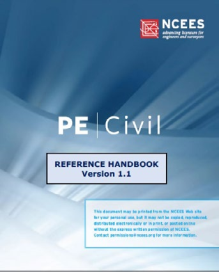
It is also important for our readers who are planning to take the PE Civil CBT exam to review the exam specifications, fees, requirements and the reference material. The new PE Civil Reference Handbook, Version 1.1 may be downloaded for free from NCEES website. To download, first register or log in to My NCEES and then go to Dashboard/Common Tasks/ Useful Documents/View reference handbooks.
The current version of the reference handbook will be supplied onscreen as a searchable PDF. All examinees will use a 24-inch monitor while testing to allow sufficient space to display both the exam question and the reference handbook. If codes, standards, or other references are being supplied, they will be listed on the last page of the exam specifications.
Typically, references are best viewed in the exam software at 100%. If additional clarification is needed, zooming to a higher or lower percentage may be helpful.
The exam fee for the new PE Civil CBT is $375 and is payable directly to NCEES. Some licensing boards may require filing a separate application and paying an application fee as part of the approval process to qualify for a seat. The examinee’s licensing board may have additional requirements as well. If you are planning to take the PE exam, familiarize yourself with your state licensing board’s unique registration procedures before registering for the exam.
Specifications and design standards
The PE Civil CBT exam is a breadth and depth examination. The breadth items cover topics from all five areas of civil engineering. The depth items focus more closely on a single area of practice. The PE Civil exam includes multiple-choice questions as well as Alternative Item Types (AITs).
For details on the format and length of the exam, the topics covered, and applicable design standards, select your engineering discipline below to download the exam specifications from NCEES’ web site, NCEES.org. PE exam specifications and design standards are posted 6 months before their effective date. Exam specifications change once every 5–7 years. Design standards change more frequently. The design standards for 2022 exams are listed below according to five civil engineering disciplines:
- Civil Eng: Construction
- Civil Eng: Geotechnical
- Civil Eng: Structural
- Civil Eng: Transportation
- Civil Eng: Water Resources and Environmental
Allowed reference materials
As mentioned earlier, the examinee will be provided with an electronic PE Civil Reference Handbook as well as all design standards specified for the chosen civil discipline during the exam. This handbook and the standards listed on the exam specifications are the only reference material that can be used during the exam.
The examinee will not be allowed to bring personal copies of any material into the exam room. Design standards are available through the publisher, typically as both an electronic and printed copy.
The handbook and design standards will be available for both the breadth and depth portions of the exam, though design standards are not needed for breadth questions. The NCEES handbook and the design standards used on the exam are searchable pdf files with linked chapters for easy navigation.
Finally, we have to remind our readers that both the FE and PE exams are very fast paced exams and you will have little time to look up information. Therefore, make sure you are familiar with your reference material and design standards. It will be helpful to begin with the subject areas you know best. This will give you more time and build your confidence.
Most importantly, stay relaxed and confident. During the exam, keep a good attitude and remind yourself that you are going to do your best!
Until next time,
Ahmet Zeytinci, P.E.